
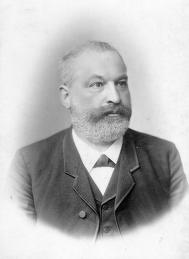
Clemens Alexander Winkler (1838–1904) was a distinguished German chemist and professor at the Freiberg University of Mining and Technology, best known for discovering the element Germanium in 1886. His discovery confirmed Dmitri Mendeleev’s theory of periodicity (specifically “eka-silicon”). He was also a pioneer in technical gas analysis and the contact method for sulfuric acid production.
Discovery of Germanium
While analyzing the mineral argyrodite, Winkler found a new element that he initially thought might be arsenic or antimony, but eventually identified as the “eka-silicon” predicted by Mendeleev 15 years prior. He named it germanium to honor his fatherland.
In 1886, Winkler was provided with a new mineral from the Himmelsfürst mine near Freiberg. The mineral, called argyrodite, was found by chemists to contain silver and sulfur. When Winkler subsequently analyzed the mineral, he found that the individual components only added up to about 93–94% of its total mass, leading him to suspect that a new and previously unknown element must be present. After additional chemical purification steps over several months, Winkler isolated the pure element, germanium, on February 6, 1886 and published his results The mineral argyrodite that was Winkler’s start toward finding germanium is now known to be a double sulfide with formula GeS2 · 4Ag2S.
To place germanium into the periodic table, Mendeleev suggested that it might be ekacadmium, an element he had predicted earlier. In contrast, Lothar Meyer favored an identification of germanium with ekasilicon, a different predicted element. Winkler isolated more of the pure material, and eventually obtained enough to measure some of its physical and chemical properties. His results showed unequivocally that Meyer’s interpretation was the correct one and that nearly all of the new element’s properties matched Mendeleev predictions. The close match between what had been predicted for ekasilicon and what was found for germanium was clear evidence for the utility and power of the periodic table and the concept of periodicity.
Academic Career: Born in Freiberg, Saxony, he studied at the Freiberg University of Mining and Technology (Bergakademie Freiberg). He later became a professor of chemical technology and analytical chemistry there.
Key Contributions
Technical Gas Analysis: He is considered the founder of modern technical gas analysis, publishing a seminal handbook on the subject.
Industrial Chemistry: Developed a contact process for producing sulfur trioxide (SO3).
Background: Son of a chemist, he had a strong foundation in metallurgy and analytical chemistry.
Awards: He was elected a member of the Royal Swedish Academy of Sciences in 1892.
Professor Clemen Winkler’s work was crucial for inorganic chemistry, proving the reliability of the periodic table, and he was known for his dedication to teaching, writing, and hands-on experimentation.